Now in closed beta for iPhone

CatalogTracker. Know what you own, track by track.

Split sheets generated from a catalogue that already holds the names and the codes — sent for confirmation, and confirmed in a browser with nothing to install.

One email to confirm, then an invitation to the TestFlight build. It needs iOS 26.4 or later. Your address is used for nothing else.

01Walkthrough

  • 01Catalogue
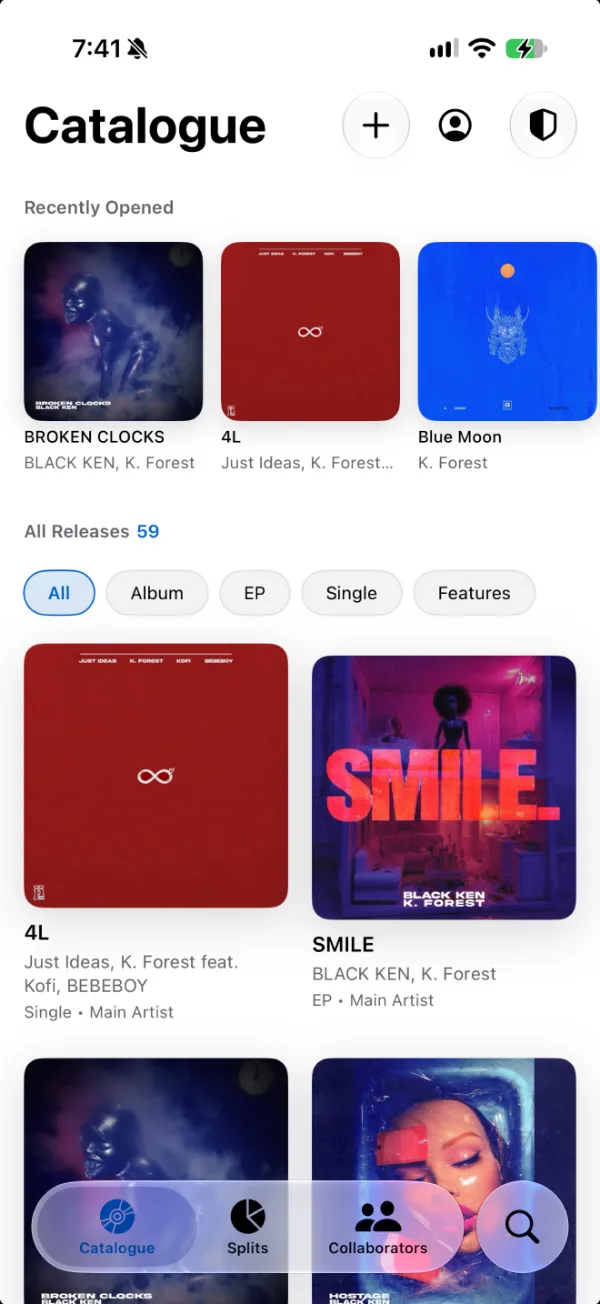
    The Catalogue screen, with recently opened releases above a grid of all 59, filtered by type, each showing cover art, artists, and role.
  • 02Agreement
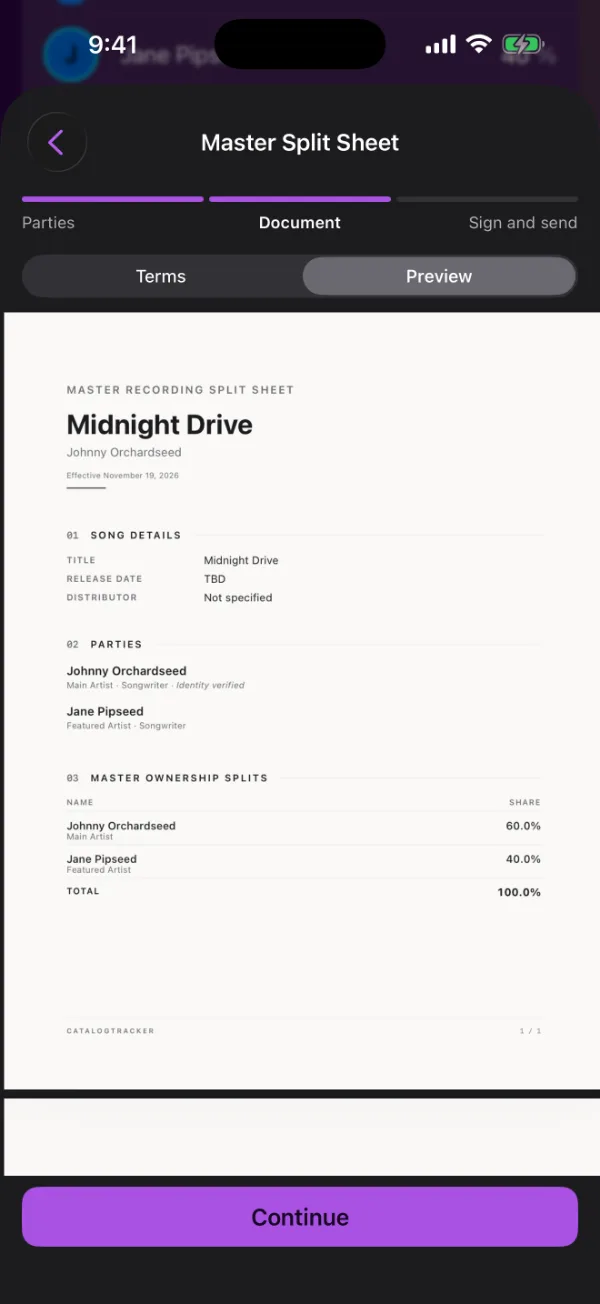
    A master split sheet previewed as a document before it is sent, with the song's details, both parties, and master ownership split 60 and 40 percent.
  • 03Sign and send
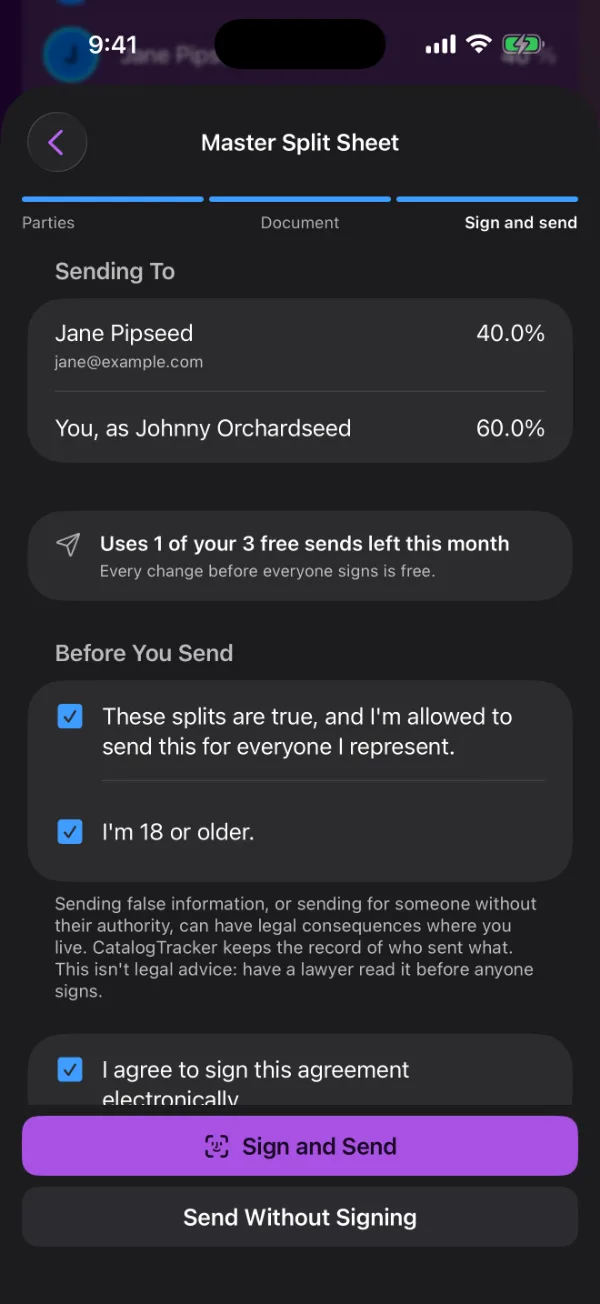
    The sign-and-send step, naming who receives the agreement and each share, with confirmations that the splits are true and the sender is 18 or older, above a Sign and Send button.
  • 04Splits
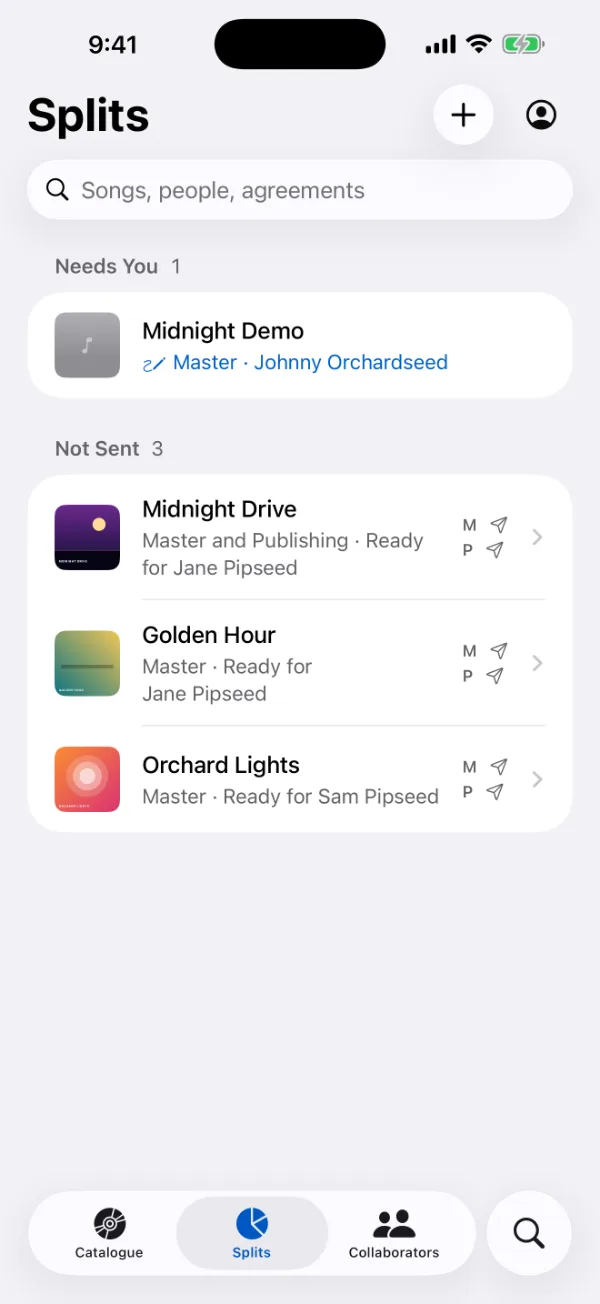
    The Splits tab, with one agreement waiting on you and three songs ready to send, each marked for master and publishing.
  • 05Split sheet
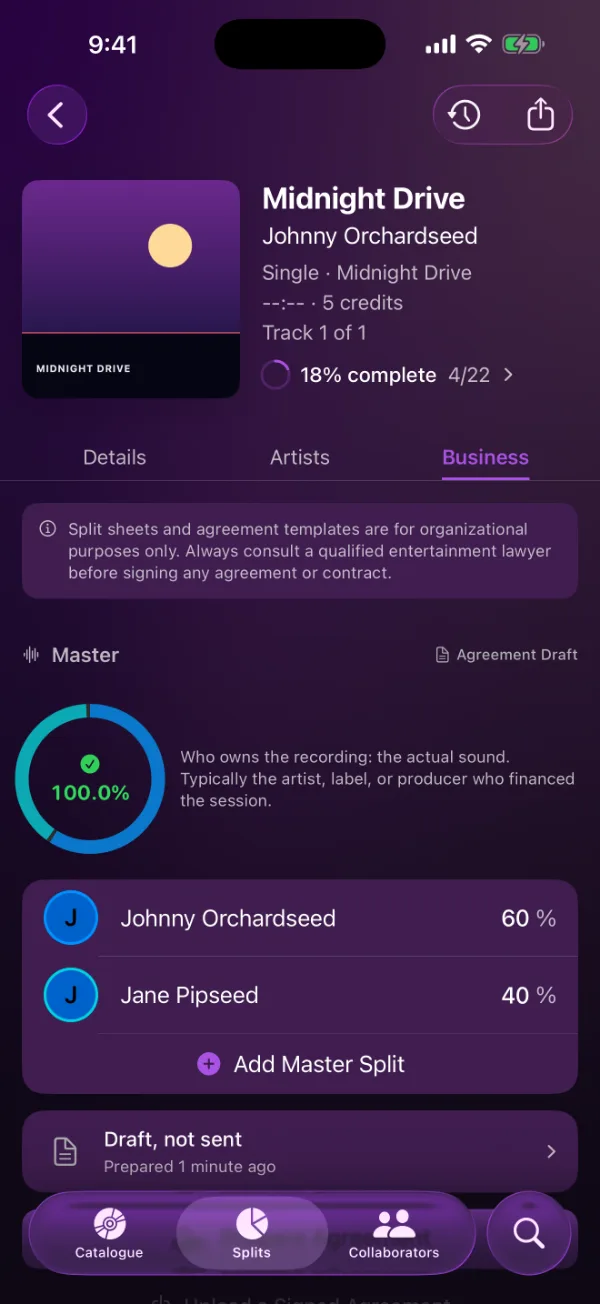
    A track's Business tab, with master ownership complete at 100 percent between two artists at 60 and 40, and an agreement drafted but not yet sent.
  • 06Credits
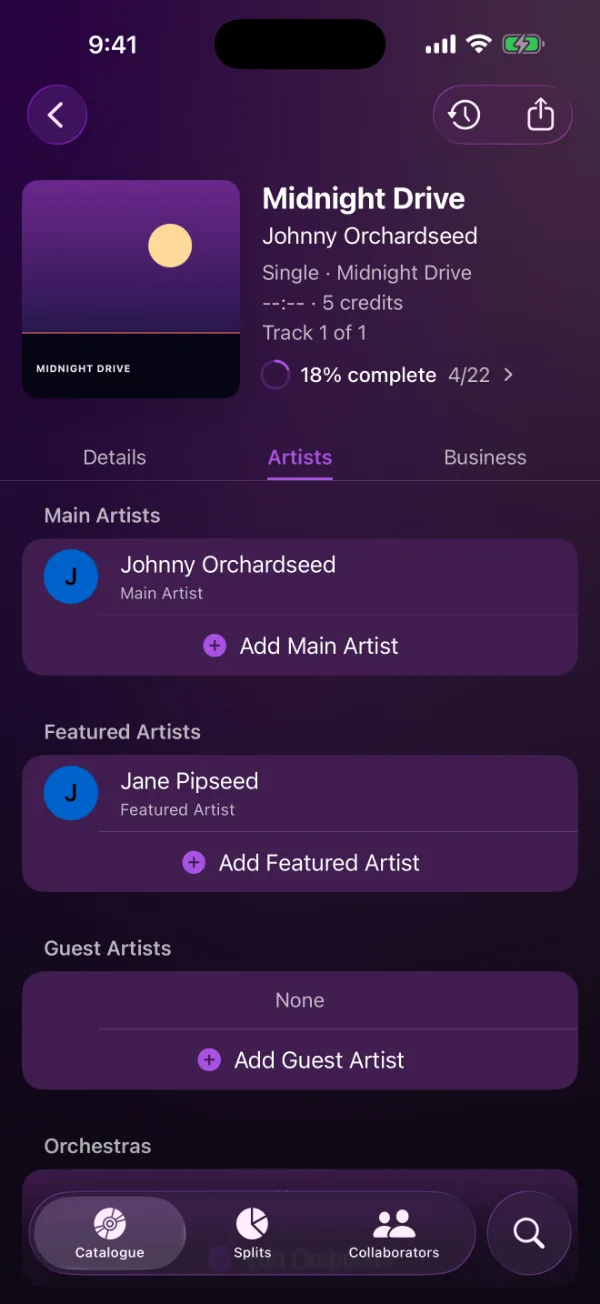
    A track's Artists tab, listing its main and featured artists by role, with a place to add guest artists.

02What it does

A split sheet generated from what is already recorded — the parties, the terms, the governing law, and somewhere to sign — rather than typed out again from memory.

Sent from the app for confirmation, and confirmed in a browser. The person agreeing installs nothing and makes no account.

Master and publishing splits kept apart, per track, each summing to its own 100 — and visibly incomplete until it does.

The catalogue underneath it, so the names and the codes are already there — every release with its artwork, its artists and its type, a completeness meter on each, and identifiers down to ISRC, ISWC, UPC, GRid, ISNI and IPI.

03Questions

How does a collaborator confirm a split?

You send it from the app and they get an email with a link. They can accept or decline in a browser — nothing to install, no account to make — and that is recorded as a web confirmation. If they already have CatalogTracker they can respond in the app instead, where it is a receipt signed by their device's Secure Enclave rather than a web response. Neither one executes the agreement itself — that is still print-and-sign.

Does CatalogTracker sign the split sheet?

No. It generates the document and records who confirmed which split; signing is print-and-sign. A collaborator's confirmation is a receipt signed by the Secure Enclave on their own device, which proves that device was present — and the app is explicit that device presence is not proof of identity.

What does CatalogTracker cost?

Nothing. The catalogue, the imports, the generated PDFs, the exports and the on-device backups are unlimited and free, and the only limit anywhere in the product is five split-sheet shares a month. There is no purchase of any kind in the app today.

Which jurisdictions do the generated agreements cover?

Four options: United States — New York, United States — Delaware, Canada — Ontario, and Other. The choice sets the governing-law clause, the statutory-rate reference and the paper size. There is no United Kingdom, European or Australian option, and every generated document is a template rather than legal advice.

Where is my catalogue stored?

On your own device. CatalogTracker is local-first, and this company's servers never hold your catalogue. The only thing that leaves is a split you choose to share, which carries that track, its identifiers, the parties, their percentages and their roles — never the rest of the catalogue. Everything except sharing and importing works with no network at all.

Can I import a catalogue I already have?

Yes, by artist name, Apple Music URL or a streaming link. The app reads the iTunes Search API, MusicBrainz and Credits.fm, and can enrich from Apple Music behind the system permission prompt. A deep import is deliberately unhurried, because MusicBrainz is throttled to one request a second — and when a match fails the app says so rather than reporting a clean success.

What does the closed beta mean for the documents it generates?

Every PDF a beta account generates carries BETA — NOT A VALID DOCUMENT across each page. It is set on the server, it cannot be switched off from inside the app, and it is there because a split sheet from an unfinished product should never be able to pass for a finished one.
04Writing

The business of an independent music career: the metadata, the agreements, and the admin nobody hands you a manual for.

  • Running a label with five artists: what has to be tracked

    What a label owes each artist, and when: the seven terms to copy from every contract, a running balance per artist, the statement and its objection clock, everyone else the records pay, and the forms each payment creates.

  • How to leave a distributor and take your catalogue with you

    Leaving is a second delivery, not a cancellation. What has to match, which goes first and where the three distributors disagree, what the cancel button really does, why Content ID runs the other way, and when the old account can close.

All writing